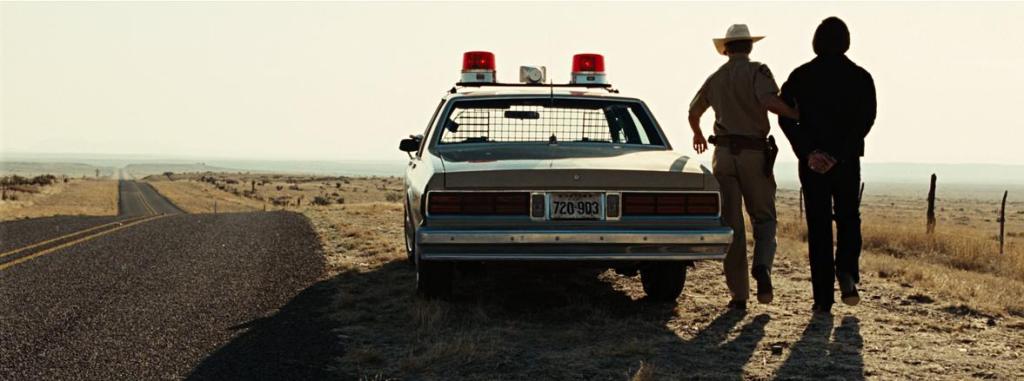
“You can’t stop what’s comin’, it ain’t all waitin’ on you… That’s vanity.”
No Country for Old Men (2007), directed by Joel and Ethan Coen
I. introduction
No Country for Old Men begins with the familiar shape of a Western: a rugged landscape, a tough protagonist, a violent antagonist, and a sheriff attempting to uphold order. But as the story unfolds, it reveals a deeper more unsettling truth. While it borrows the form of the genre, the film ultimately shifts its focus toward a far less tangible enemy: a world not governed by justice or morality, but by indifference. Through Moss, Sheriff Bell, and Chigurh, the film interrogates the human need for order in the face of a universe that offers none.
The narrative follows three characters. Llewelyn Moss, a veteran who stumbles upon drug money and chooses to keep it. Anton Chigurh, the relentless hitman pursuing it. And Sheriff Bell, an aging lawman struggling to comprehend the relentless violence. At first, it seems like a standard pursuit story, but as events spiral beyond logic or control, the film takes a darker turn. It becomes an exploration of how each character confronts the unsettling truth that the world is not merely dangerous, but fundamentally indifferent.
Each figure embodies a different response to that indifference. Moss embodies pragmatic individualism, Bell represents a kind of disillusioned realism, and Chigurh uses his rigid, self-made code as a twisted form of fatalism. All are desperate attempts to impose order on a world that resists understanding, and none succeed.
II. Llewelyn Moss- The Individualist
Moss is the most relatable figure in the film. He’s a veteran and a hard-working family man; a portrait of American self-reliance. His discovery of the money in the aftermath of a drug deal gone wrong drives him into a story that plays out like a classic cat-and-mouse thriller. Moss enters the story believing that he is the type of man who will survive, but the film challenges this belief at ever turn.
His decision to take the money is framed as a choice, but it marks the moment he unknowingly forfeits control. He tries to stay ahead through grit, intelligence, and tactical skill, but the world he’s entered doesn’t operate by those rules. His skills are real, but irrelevant. His downfall begins with a seemingly moral impulse: returning with water for a dying man. That single act reorients the entire structure of the chase.
Moss embodies the myth of the American individualist, presenting as a man who believes he can outwit fate with enough toughness and instinct. In another film, Moss might have been the hero who triumphs. Here, he dies unceremoniously and offscreen. His death is not only unexpected; it is deliberately anticlimactic. This narrative decision strips away the illusion of control and dispels the idea that merit alone can suppress the chaos. Moss believed he could manage the consequences of his actions. The film insists otherwise. In this world, agency is fragile, and fate is not shaped by character or competence.
III. Sheriff Bell- The Disillusioned Moral Realist
Sheriff Bell has spent his life playing the game by the rules, or at least believing in the rules that once mattered. He follows in his father’s footsteps, upholding the law with a quiet sense of duty and authority. But as violence escalates beyond anything he recognizes, Bell begins to suspect that the system he once trusted no longer exists, or perhaps never did.
Throughout the film, Bell turns to stories, memories, and dreams, searching for coherence. His narration is full of longing for a time when the world seemed understandable. Yet it becomes clear that what he’s mourning is not just the loss of order, but the possibility that it was an illusion all along.
The dream he recounts at the end, in which his father rides ahead with a lantern into darkness, is not a vision of hope, but a surrender to the unknown and a recognition that the meaning may lie outside the realm of reason. Bell’s retirement is not only physical; it is philosophical. He steps away because he realizes that the tools that he has relied on; law, morality, and tradition, no longer keep him grounded. The world has changed, or perhaps it has merely revealed its true nature, and he no longer has a role in it.
Iv. Anton Chigurh- The Fatalist
Anton Chigurh appears, at first, to be the embodiment of inevitability. He speaks little, kills without emotion, and adheres to an abstract personal code. He offers coin tosses in place of explanations and frames death as predetermined. “The coin got here the same way I did,” he says, as if denying all responsibility. Chigurh does not see himself as a killer, but as an instrument, enforcing consequences dictated by rules only he fully believes in.
To others, Chigurh appears invincible, almost inhuman. But the film gradually dismantles this illusion. His “code” is arbitrary and inconsistent. When Carla Jean refuses to call the coin toss, she forces him to acknowledge the truth: that the choice is his, not the coin’s. His moral logic collapses the moment someone refuses to play.
In the film’s final moments, Chigurh is badly injured in a car crash. The event is random, brutal, and unearned. In the end, Chigurh is not death, not fate, not inevitability, he is simply another man trying to impose meaning on a world that doesn’t care.
v. An Indifferent World- The True Antagonist
No Country for Old Men strips its characters of comfort. It offers no catharsis, no moral resolution, and no satisfying answers. What it leaves behind is something colder: a world in which systems exist, but those systems are not rational, moral, or fair. It is not cruel in the traditional sense. It is indifferent. All three main characters attempt to confront this indifference. Moss fights it through action. Bell retreats into memory. Chigurh constructs a personal system of order. But none of these approaches succeed. The world absorbs them all and continues on, unmoved.
Perhaps the most revealing line in the film comes not from one of the leads, but from Carson Wells, a side character. He says, “I counted the floors to this building from the street, and there’s one missing.” It seems like an offhand remark, but it captures the film’s deeper message. The world appears structured and logical, but something doesn’t quite add up. The systems we live by are flawed, incomplete, and sometimes illusory.
In the end, this is not a battle between good and evil. It is a quiet, haunting story about what happens when human strategies meet a universe that does not explain itself. No Country for Old Men serves as a stark confrontation between its characters and a world that denies their need for reason.


Leave a Reply